Picture the “typical” sleep apnea patient. Most people imagine a heavy-set man with a thick neck, snoring like a freight train. That picture comes straight out of Western medical textbooks.
In South Asia, that picture is often wrong.
A slim 38-year-old software engineer. A 52-year-old mother who “just feels tired all the time.” A school teacher whose family jokes that his snoring rattles the windows. Any of them could have moderate-to-severe obstructive sleep apnea (OSA), and most would never be flagged by the standard tests.
In the September 2026 edition of ISSS Sleep News, Dr. Srinivas Kishore Sistla brought together the latest research on how sleep apnea is different in South Asians. Here’s what every South Asian family should know.

- About 1 in 9 Indian adults has sleep apnea, and most don’t know it.
- South Asians get serious apnea at a lower body weight (BMI 25–27, not 30+).
- The cause is often jaw and airway bone structure, not just fat.
- Standard screening questionnaires miss many South Asian cases.
- Jaw-advancement surgery works especially well in Asian patients.
What is sleep apnea? (30-second version)
In obstructive sleep apnea, the airway at the back of your throat narrows or collapses again and again while you sleep. Breathing becomes shallow or stops for several seconds, oxygen levels drop, and your brain jolts you partly awake to restart breathing. This can happen dozens of times an hour without you remembering it.
Mild
Moderate
Severe
AHI (Apnea-Hypopnea Index) = the number of breathing pauses or slow-downs per hour of sleep.
The numbers are staggering
A 2023 meta-analysis from AIIMS, New Delhi, found that about 11% of Indian adults have OSA. That’s roughly 1 in every 9 adults.
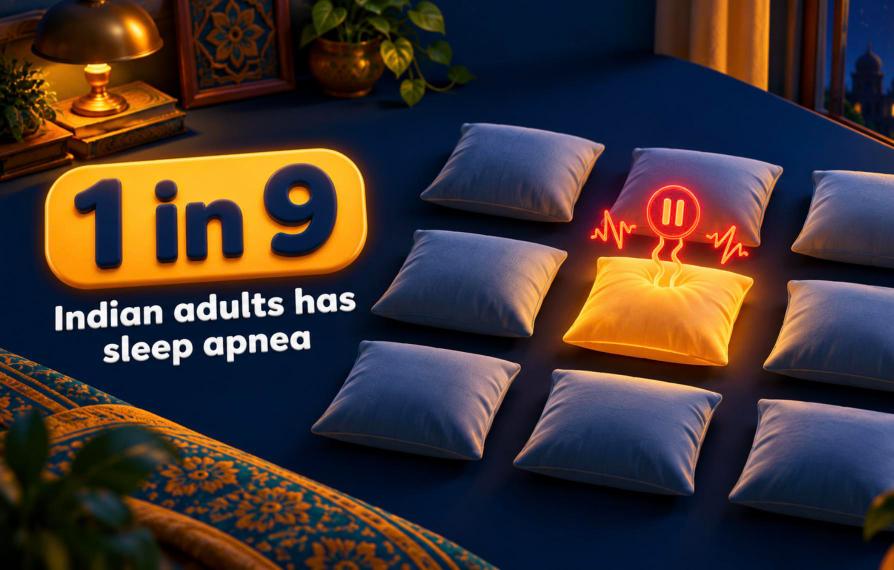
Moderate-to-severe sleep apnea is linked to high blood pressure, heart disease, stroke, diabetes and road accidents. Yet most of these people have never had a sleep study. Women are also very likely under-counted.
Surprise #1: You don’t have to be overweight
In the West, the main trigger for OSA is excess weight, especially fat around the neck. Doctors traditionally start worrying at a BMI of 30 or more.
In South Asians, moderate-to-severe OSA is frequently seen at a BMI of just 25–27. Many of these patients would be told they’re “only slightly overweight”, or even perfectly fine. Two reasons:
Surprise #2: It’s often in the bones, not the belly
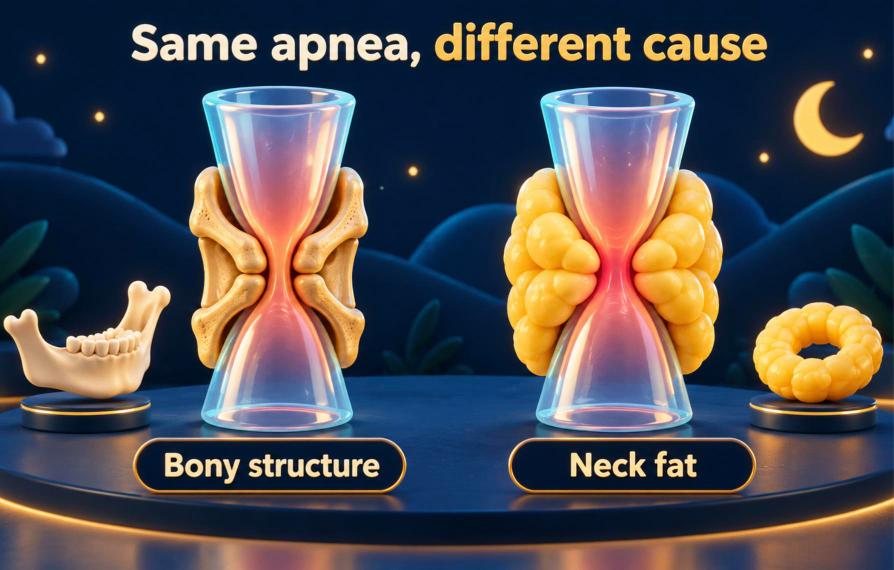
In white patients, soft tissue and fat are the main culprits. In South Asian and other Asian patients, the skeleton of the face and jaw plays a much bigger role.
| South Asian / Asian | Caucasian | |
|---|---|---|
| Main cause | Bony structure of face & jaw | Body fat, esp. the neck |
| BMI at onset | 25–27 | 30+ |
| Lower jaw | Set-back jaw more common | Less often set back |
| Airway inlet | Narrower bony inlet | Wider; narrowed by fat |
| Soft palate | Longer | Shorter |
| Neck size | Smaller, a weak clue | Larger, a strong clue |
A landmark study of 164 Asian and 75 white patients in Hong Kong and Vancouver found that, for the same severity of apnea, Asian patients had more pronounced skeletal differences and were significantly less obese. A 2020 study in SLEEP using 3D CT scans confirmed it: Asian patients had smaller airways despite lower BMIs.
Surprise #3: Your neck size may fool the doctor
Neck circumference is built into most screening tools because it predicts apnea well in Western patients. South Asian necks tend to be smaller, so neck size is a much weaker clue, and relying on it can easily miss the diagnosis.
Why sleep apnea stays hidden in South Asia
A 2026 review of over 51,000 patients confirmed that sleep apnea is under-diagnosed in ethnic minority groups worldwide. In South Asia, four barriers stand out.
The screening problem: tests built for someone else
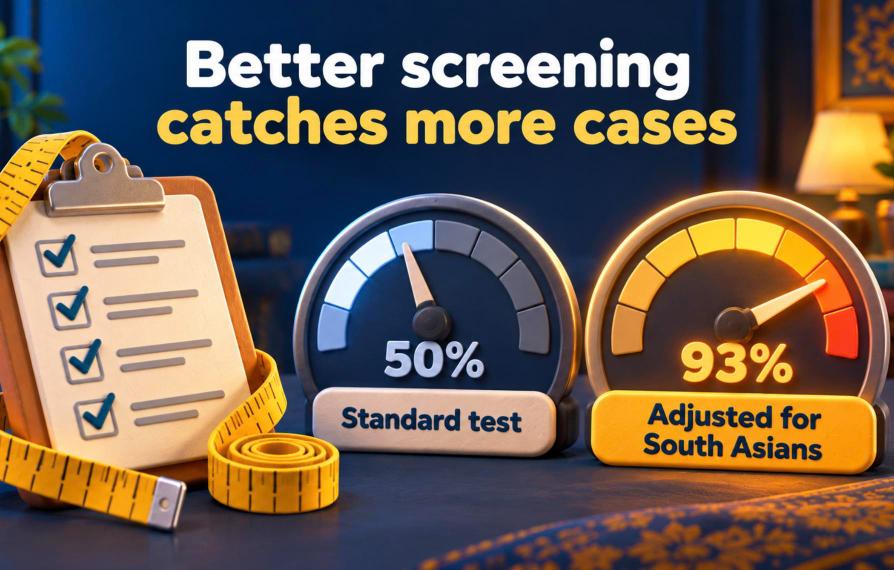
Doctors often use quick questionnaires like STOP-BANG and the Epworth Sleepiness Scale (ESS) before ordering a sleep study. Both were developed mainly in Western, heavier populations, and they can badly underperform in South Asians.
Quick self-check: should you get evaluated?
If several of these apply to you or a loved one, talk to a sleep specialist:
This is not a diagnosis. Only a sleep study can confirm OSA.
The good news: treatment works, sometimes even better for us
Because so much South Asian sleep apnea comes from bone structure, surgery that corrects the skeleton can be especially effective. A 2024 meta-analysis of maxillomandibular advancement (MMA), surgery that moves the jaws forward to open the airway, found Asian patients improved more than Caucasian patients.

Frequently asked questions
I’m not overweight. Can I still have sleep apnea?
Yes. In South Asians, moderate-to-severe OSA is commonly seen at a BMI of 25–27, and sometimes lower. A narrow jaw or airway can be enough on its own.
Is loud snoring a sign of deep sleep?
No. Loud, regular snoring means air is struggling through a narrowed airway. It is one of the most common warning signs of sleep apnea.
Why might a screening questionnaire miss my sleep apnea?
Tools like STOP-BANG and the ESS were built mostly on heavier Western patients. They miss many South Asian cases unless the cut-offs are adjusted, for example using BMI ≥23 instead of 35 and adding waist size.
Do women get sleep apnea too?
Yes. Women are diagnosed less often, partly because their symptoms can be subtler (fatigue, insomnia, headaches, low mood) and partly because they are referred for sleep studies less often.
CPAP feels hot and uncomfortable. Are there other options?
Auto-adjusting PAP machines with heat-moisture exchangers are much more comfortable in hot, humid weather. If your apnea is driven by jaw or airway structure, surgery such as MMA or hypoglossal nerve stimulation may be considered after proper evaluation.
Why do I need X-rays or a CT scan for sleep apnea?
Because in South Asian patients, bone structure is often the main cause. Imaging shows exactly where and why the airway is narrowing, which is essential for choosing the right treatment, especially surgery.
ENT and sleep surgeon specialising in snoring, obstructive sleep apnea and other sleep-related breathing disorders. He serves on the Board of the International Surgical Sleep Society (ISSS) as Member At-Large for Asia, and wrote “OSA in South Asia: Racial, Cultural & Demographic Disparities” for the September 2026 ISSS Sleep News.
Consult him for: snoring assessment · sleep apnea diagnosis & sleep studies · airway evaluation & imaging · CPAP guidance & alternatives · sleep apnea surgery
📖 Read the original article: OSA in South Asia: Racial, Cultural & Demographic Disparities (ISSS, PDF)
📰 Full newsletter: ISSS Sleep News, Fall Edition, September 2026 (PDF)
Key references
- Suri TM, et al. Prevalence of obstructive sleep apnea in Indian adults: systematic review and meta-analysis. Sleep Med Rev. 2023;71:101829.
- Lam B, et al. Craniofacial profile in Asian and white subjects with obstructive sleep apnoea. Thorax. 2005;60(6):504–510.
- Differences in three-dimensional upper airway anatomy between Asian and European patients with OSA. SLEEP. 2020;43(5):zsz273.
- Thomas S, et al. Racial and ethnic disparities in the diagnosis and treatment of OSA: a systematic review. Int J Environ Res Public Health. 2026;23(5):614.
- Sinsopa N, et al. Modified STOP-Bang questionnaire for detecting OSA in individuals with BMI below 35 kg/m². PeerJ. 2025;13:e20310.
- Haldar A, et al. STOPBANG vs. STOPBWANG in an Indian cohort. Lung India. 2026;43(3):253–257.
- Dogra M, et al. STOP-BANG score versus Epworth Sleepiness Scale as a screening tool for OSA. Int J Appl Basic Med Res. 2025;15(2):116–121.
- Sinha S, et al. A BMI-independent (SWET) score to predict moderate or severe OSA in the Indian population. Am J Respir Crit Care Med. 2025;211(Suppl 1):A4751.
- Nanu DP, et al. Racial variations in maxillomandibular advancement for OSA: a systematic review and meta-analysis. Sleep Breath. 2024;29(1):55.
This article is for general awareness and does not replace a medical consultation. If you have symptoms of sleep apnea, please see a qualified sleep specialist.